After driving a Land Rover for a while, you start to feel in tune with the vehicle. Gear changes are smoother, there’s less body roll in the corners and you can judge the turning circle properly. And then, something doesn’t feel quite right. Is that a sound that you’ve never heard before? A noise that doesn’t become any louder, but becomes more and more noticeable. Slightly mechanical, slightly echoey and you just can’t put your finger on it.
Experience has taught me that by the time something makes a noise on a Land Rover that it shouldn’t be, it’s already time to replace it. It is literally the vehicle telling you that something’s wrong. Of course the easiest solution is to turn the radio up, but somewhere along the line something will jump up to bite you when the noise gets a lot louder and violent, and then for some reason, the Land Rover won’t drive….
If you ask yourself a few key questions, then you may be on the way to finding out what’s crying out in pain.
Where is it coming from?
Is it from the engine? Is it left or right, front or back? If you find it hard to discern where the noise is coming from, it probably means it’s right underneath the vehicle and the sound is reflected from the road surface.
When does it make the noise?
Nine times out of ten the noise will come from a moving part and can be pinpointed to when that system is functioning. Is it noisy accelerating or decelerating? Braking or crusing? On idle, when you change gear, when you depress the clutch or turn the steering wheel? This can narrow it down to the vehicle system involved.
What motion could create that noise?
With the type of noise, you can help further identify systems involved from what its parts might be doing. Is the noise grinding like metal on metal? Is it tapping, or clunking? Or a whine or hiss?
Some recognisable noises
These are some of the noises that I have eventually deduced, which now signal a recognisable issue is at hand.
- Worn Universal Joint: a rattling metallic noise under acceleration or deceleration
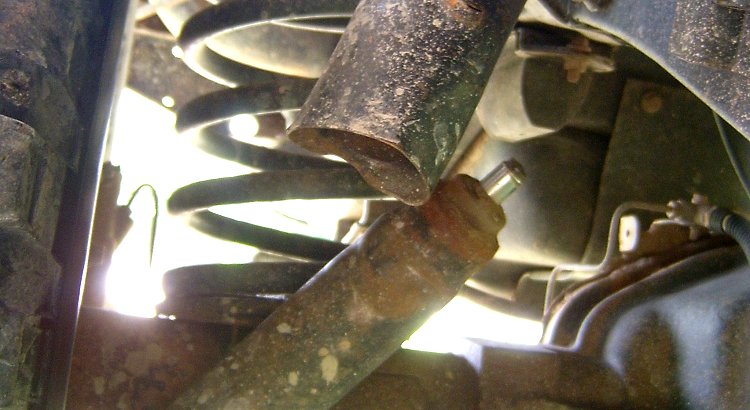
- Loose shock absorber/trumpet: A clang from the front sounding like Morse code
- Worn brake pad: A grinding more apparant on cornering when more pressure is against the troublesome brake pad
- Leaky intercooler pipe: A chuffing sound from the bonnet as air escapes
- Rear lower link bush: A clunk from the back as you rapidly decelerate
- Detached A frame bracket: A low sounding clunk on uneven ground
- Bent Track rod: A grinding and vibration in the steering as it rubs the steering guard
- Broken Viscous Unit (Fan): A grinding and rattling from the engine that doesn’t go away on idling
- Worn Gearbox Roller Bearings: A whine from the central console
- Worn Clutch release bearing: The noise from the vehicle changes when you depress the clutch
This list is by no means exhaustive. Sometimes there can also be multiple sources of a noise. The A frame bracket that sheared off illuded me for a while, as the noise wasn’t very noticeble when driving, just a low clunk, and wasn’t able to be seen unless you laid right under the rear axle.
Invariably though, it pays to be in tune with noises that appear in your Land Rover, to prevent things becoming more costly in a month or so. Or just turn the radio up.
What other noises immediately signify to you that something’s gone wrong? Maybe you’d like to contribute an article or comment below.
Related posts:
- Out of Office
At least for a bit i got to have a...

Thanks. That is great info. Any ideas of a clunk around the front driver side usually when turning to the right? It happened before I fitted my 110 with all new polybushes, swivel housings, brake calipers and pads, springs and shocks etc. and it continues to happen after all this work. The noise suggests it is coming from the steering? It only happens on the move, making it hard for me to diagnose at a standstill. I can’t feel any play. It always feels like the clunk is a physical seize and then release under my right foot when driving. Any advice would be great.
Hiya
It sounds like you’ve had a good go at tracking down the noise. All that’s left to suggest are the steering components. Check the Universal joint on the steering column under the bonnet, the ball joints on the power steering box drop arm and track rod, and also the bushes around the steering damper. Maybe take off the damper and check for full movement too.
Is the clunk when starting, finishing or during a turn? Is it constant or only once? If there’s a reluctance to turn then something that should be moving isn’t or getting caught somewhere.
You could jack up the front wheels and put them on axle stands and turn the steering from lock to lock. It might not have the same effect as the forces are less than when moving, but it’ll be easier to pick out noises. You can then grab the wheels fully and rock them in all directions checking the wheel bearings and the swivel bearings that allow the hub to rotate.
Will
Thanks Will,
Following your advice I took a look on Saturday. It seems to be the ball joint on the drop arm. It was only put on recently after the chassis change and has been binding enough to make a crunching sound only when turning right. I re-adjusted it following the green LR bible it and all seems ok so far!!!
Thanks for replying so quickly.
Hi,
I also have noise when turning, but it only occurs when I turn to the left. It goes away if I press the clutch and only occurs at slow speeds while accelerating. Driving in a circle is a sure way of getting it going. It’s a groaning/winding sound and comes from the left (I think!) front.
I drive a Defender 130 left hand drive, 2000 model with 72000km on the odo.
The CV-joints are nicely greased and there is no play.
Any ideas?
Regards,
Mattias
Hi Mattias
CV joints are certainly something to think about, but you say these are okay. The bearings would be my next assumption. When you turn left it would be the right hand wheel that is taking more force and could be causing the noise. Maybe check to see if the brake pads are sticking on.
I once had a damaged rear wheel bearing and when I turned right it would make the brake disc grind against the brake pads.
The fact you say that the noise occurs only during acceleration means that it could also be attributed to the Universal joints, which are very sensitive to acceleration and deceleration, and usually only make a noise in one of those cases.
I hope this helps.
Will
Hi,
Thank you! You were absolutely right! I added more grease to both cv-joints and the noise disappeared! Perhaps a temporary fix, but no more loud noises while turning left at least.
Will see about new cv-joints after Xmas.
Regards,
Mattias
Hi,
Iv fitted a 2″lift on my 110 and when i change up i get a metalic rattle sound from in front of me, could this be from the prop shaft? What is the solution if so?
Great web site btw, i also share your dream of taking my landy off road. Money is my biggest problem lol.
Thanks
Nick
Hi Nick
If the noise coincides with fitting the lift kit then it’s almost certainly related to the universal joints, unless there are bushes that are loose from fitting the new suspension bits.
Get underneath and wiggle the propshaft to see if any bits of it move independently from the rest. If so then fitting a “wide yoke propshaft” might be the answer so that it doesn’t get as stressed from the increase in angle. A 2 inch lift is at the limits of the factory designed proshaft.
Tell me about it with the money… Spanking Land Rovers are expensive!
Cheers,
Will
Hi
I have a 2001 p38 (last of the this shape) when i start it up it makes a sound like a chuffing noise coming from the drivers side (RHS) the noise gets faster as i accelerate but goes quite as i coast!! to discibe the sound better, it sounds like a cross between ticking and chuffing.
Any ideas?
Thanks
SCOTT